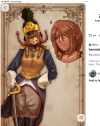








Purpure Longstride
Sailor Apprentice
New Weibermacht Masterpost
This was originally posted to my Tumblr on 4th July 2025. Due to how I modified the CSS, you'd need the direct link to share it around.TLDR? New Weibermacht is about women behaving like men.
Edit 30 September 2026: I have been informed that the phrase Weibermacht still carries negative connotations to German ears. Future descriptions of this genre will alternately refer to "women warriors", "Kingdom of Women," or "women at large" where applicable.
Introduction: What is Weibermacht?
A German phrase meaning “Women Power,” and usually defined as “Women acting like men in gender role reversals, as a warning against emasculation.”
In the Reinaissance around 1450, an artist known as Master of The Weibermacht lived in the Rhine Country, producing sketches and engravings on the subject of women’s power. Lucas of Cranach is also another exemplar of the Weibermacht artists.
Today, Weibermacht has taken on another meaning, which this series aims to explore.
For the sake of clarity, New Weibermacht is defined as “Modern indie art movement where women act like men in gender role reversals, but as a celebration of the potential of women.” Chronologically, New Weibermacht can span from prehistoric eras all the way to our present, and sometimes into an imaginary future.
Current focus of this post series is on the visual arts and iconography of heroic and/or fighting women.
In the Reinaissance around 1450, an artist known as Master of The Weibermacht lived in the Rhine Country, producing sketches and engravings on the subject of women’s power. Lucas of Cranach is also another exemplar of the Weibermacht artists.
Today, Weibermacht has taken on another meaning, which this series aims to explore.
For the sake of clarity, New Weibermacht is defined as “Modern indie art movement where women act like men in gender role reversals, but as a celebration of the potential of women.” Chronologically, New Weibermacht can span from prehistoric eras all the way to our present, and sometimes into an imaginary future.
Current focus of this post series is on the visual arts and iconography of heroic and/or fighting women.
Is Weibermacht Just A Femdom Kink?
At first glance, with the popularity of both Old and New Weibermacht among straight men, it would appear so. However, to dismiss it as a femdom kink is flippant. It is true that scenes in Old Weibermacht resemble femdom to modern eyes, especially the topics “Phyllis Astride Aristotle,” and “Battle of The Breeches.”
Then again, other scenes in Old Weibermacht depict straightforward battles between the sexes or Biblical heroines, so the distinction between satire, kink, and admiration are blurred.
Similar ambiguity exists within the New Weibermacht between kink and admiration. Due to our modern way of thinking, this genre is less of a warning against emasculation and more of an expression of attraction.
Then again, other scenes in Old Weibermacht depict straightforward battles between the sexes or Biblical heroines, so the distinction between satire, kink, and admiration are blurred.
Similar ambiguity exists within the New Weibermacht between kink and admiration. Due to our modern way of thinking, this genre is less of a warning against emasculation and more of an expression of attraction.
Social Progress Shaping New Weibermacht
The Weibermacht genre was once the domain of white men working as artists in the Renaissance. Many of their depicted scenes were derived from Biblical stories or Greco-Roman mythology, such as Judith slaying Holofernes, Jael hammering Sisera, Omphale making Heracles work as her maidservant, and Salmacis chasing after Hermaphroditus.
Artemisia Gentileschi is one of the very few known women artists who have interpreted the Weibermacht from a woman’s perspective as raised and surrounded by men. This potentially parallels some of the 2020s New Weibermacht members’ situations where a predominantly male audience interacts with female artists.
For quite a long time, women were relegated to the sidelines in popular thinking unless they were incredibly extraordinary, both in fiction and real history. It would take the sufragette movement for the idea of women as people to really gain steam and to challenge the popular notion of women only being on the sidelines.
While women as protagonists were around and more common especially after the 1970s, what with Ellen Ripley, Lara Croft, Princess Leia, and more; New Weibermacht as an art movement didn’t gain traction until the 2020s online.
Although the Weibermacht genre didn’t start from feminist ideals, there’s an increasing influence of feminist and egalitarian ideals in the New Weibermacht genre. Each element of the New Weibermacht reflects at least one feminist wave from our world’s social history, either directly or indirectly depending on the artist.
Some New Weibermacht works such as those by Ironlily and Gambargin depict women in women’s roles of nuns and working wives, though still have a full story in the details.
The most famous New Weibermacht works are notable in their complete absence of men. While this is generally accepted as a premise for fanservice (e.g. CenturiiC), some actually try to explore what an all-woman society would be like (e.g. Ironlily, Morikoa). Some go with highlighting women alongside men (e.g. Gambargin, Basedbinkie, TangW, Meto30, Duc de Vinny)
Most importantly, no New Weibermacht character is condemned by the viewer/artist for their in-story choices beyond what is reasonably a consequence of a folly, although fictional characters’ agency is still subject to the artist’s pen.
Gender questioning is more prominently espoused in New Weibermacht, though as of current writing, transpeople are a minority subject. There is no doubt that New Weibermacht has attracted transpeople as fans, however. As yours truly is not a trans person, any further explanation on this topic is beyond the scope of this series.
Artemisia Gentileschi is one of the very few known women artists who have interpreted the Weibermacht from a woman’s perspective as raised and surrounded by men. This potentially parallels some of the 2020s New Weibermacht members’ situations where a predominantly male audience interacts with female artists.
For quite a long time, women were relegated to the sidelines in popular thinking unless they were incredibly extraordinary, both in fiction and real history. It would take the sufragette movement for the idea of women as people to really gain steam and to challenge the popular notion of women only being on the sidelines.
While women as protagonists were around and more common especially after the 1970s, what with Ellen Ripley, Lara Croft, Princess Leia, and more; New Weibermacht as an art movement didn’t gain traction until the 2020s online.
Although the Weibermacht genre didn’t start from feminist ideals, there’s an increasing influence of feminist and egalitarian ideals in the New Weibermacht genre. Each element of the New Weibermacht reflects at least one feminist wave from our world’s social history, either directly or indirectly depending on the artist.
- First wave – To ensure society sees women as people, not property.
- Second wave – Questions the “established” norms expected of women and the institutions around them.
Some New Weibermacht works such as those by Ironlily and Gambargin depict women in women’s roles of nuns and working wives, though still have a full story in the details.
The most famous New Weibermacht works are notable in their complete absence of men. While this is generally accepted as a premise for fanservice (e.g. CenturiiC), some actually try to explore what an all-woman society would be like (e.g. Ironlily, Morikoa). Some go with highlighting women alongside men (e.g. Gambargin, Basedbinkie, TangW, Meto30, Duc de Vinny)
- Third wave – Encourages self expression, self love, and self knowledge of sexuality. Follows into the internet age.
Most importantly, no New Weibermacht character is condemned by the viewer/artist for their in-story choices beyond what is reasonably a consequence of a folly, although fictional characters’ agency is still subject to the artist’s pen.
Gender is never a moral failing or a reason to underestimate a character in New Weibermacht.
- Fourth wave – Global view and not just white women, but women from around the world and LGBTQA+.
Gender questioning is more prominently espoused in New Weibermacht, though as of current writing, transpeople are a minority subject. There is no doubt that New Weibermacht has attracted transpeople as fans, however. As yours truly is not a trans person, any further explanation on this topic is beyond the scope of this series.
Global Perspectives on New Weibermacht, Genre Origins, Genre Conventions
While it is unclear who exactly started the genre of New Weibermacht, it is likely that the popularity of military tomboys as a modern otaku concept began in anime fandom, particularly with the series Fate Stay Night, Kancolle, or Blue Archive. This is a common opinion held in Asian societies, as any equivalent artistic movement to the Old Weibermacht did not exist in the Sinosphere’s history.
For the Western and American members of New Weibermacht, general historical interest plays as much of a role as rule 63 does. However, the term Weibermacht is so obscure in the present day that even Western artists focusing on historical action women are unfamiliar with the subject without clarification.
New Weibermacht as an indie movement can only be traced with certainty to the early 2020s or late 2010s, and likely began from CenturiiC, Ironlily, or Gambargin. All three of these artists were active just before 2020.
How does the meme of rule 63 play into New Weibermacht? It’s the general curiosity often shown in genderbending fiction and gijinka (anthropomorphism), basically what if women dressed and acted like men. CenturiiC is an example of using rule 63 in her New Weibermacht works, having especially stated that there are no men in her works due to personal preference.
Although Ironlily usually depicts women, they are not against depicting men in their works, nor do they make explicit use of rule 63. At one point, they worked on a book all about men in the Roman Army as a collaboration with M48James, a Roman reenactor in Taiwan.
Gambargin seems to prefer highlighting actual women from history or metaphorically retell historical situations from women’s perspectives with her Historically Wrong Sketches, often featuring men as well.
After the popularity of New Weibermacht made it a global internet movement, more artists from around the world joined in. The majority of them come from Korea, Japan, Hong Kong, USA, Taiwan, or Europe. However, it is gaining traction in Southeast Asia.
In each interview with the artists of the New Weibermacht, one recurring theme stands out in their starting interests; their attraction to and admiration of women, or a curiosity on alternate takes.
For the Western and American members of New Weibermacht, general historical interest plays as much of a role as rule 63 does. However, the term Weibermacht is so obscure in the present day that even Western artists focusing on historical action women are unfamiliar with the subject without clarification.
New Weibermacht as an indie movement can only be traced with certainty to the early 2020s or late 2010s, and likely began from CenturiiC, Ironlily, or Gambargin. All three of these artists were active just before 2020.
How does the meme of rule 63 play into New Weibermacht? It’s the general curiosity often shown in genderbending fiction and gijinka (anthropomorphism), basically what if women dressed and acted like men. CenturiiC is an example of using rule 63 in her New Weibermacht works, having especially stated that there are no men in her works due to personal preference.
Although Ironlily usually depicts women, they are not against depicting men in their works, nor do they make explicit use of rule 63. At one point, they worked on a book all about men in the Roman Army as a collaboration with M48James, a Roman reenactor in Taiwan.
Gambargin seems to prefer highlighting actual women from history or metaphorically retell historical situations from women’s perspectives with her Historically Wrong Sketches, often featuring men as well.
After the popularity of New Weibermacht made it a global internet movement, more artists from around the world joined in. The majority of them come from Korea, Japan, Hong Kong, USA, Taiwan, or Europe. However, it is gaining traction in Southeast Asia.
In each interview with the artists of the New Weibermacht, one recurring theme stands out in their starting interests; their attraction to and admiration of women, or a curiosity on alternate takes.
The New Weibermacht grew from attraction and admiration.
Technology and New Weibermacht
The New Weibermacht works are almost all posted on Twitter (a.k.a. X) as most of the founding members or prolific artists prefer to use Twitter. More often than not, New Weibermacht artists who focus on comic-styled presentations will use Twitter.
Occasionally, some New Weibermacht members post on Facebook and/or Instagram as well, especially artists located in South East Asia or those who prefer to expound on their work in supplementary texts.
Regardless of where New Weibermacht artwork is posted, the internet’s reach means that works can be shared by anyone across the globe.
Occasionally, some New Weibermacht members post on Facebook and/or Instagram as well, especially artists located in South East Asia or those who prefer to expound on their work in supplementary texts.
Regardless of where New Weibermacht artwork is posted, the internet’s reach means that works can be shared by anyone across the globe.
Interviews of New Weibermacht Artists
These are links to interviews of various artists involved in the New Weibermacht genre. They will take you to other Tumblr posts on this blog.
Multiple names listed on the same entry are other usernames used by the artist.
Some artists chose to be anonymous for personal reasons.
Interviews are taken verbatim from internet communication, so some typos may exist.
Multiple names listed on the same entry are other usernames used by the artist.
Some artists chose to be anonymous for personal reasons.
Interviews are taken verbatim from internet communication, so some typos may exist.
Citations
The Free Library - Shedevils, Harlots, and Harridans in Northern Renaissance Prints.
Leah M. Seaman - Depiction of Female Emotion As Seen Through The Work of Renaissance Artists.
Know Your Meme - Tomboy.
The Femme Fatale in Vogue.
Master of Weibermacht’s Known Artworks.
Otaku and the Beautiful Fighting Girl (Reddit Discussion).
Leah M. Seaman - Depiction of Female Emotion As Seen Through The Work of Renaissance Artists.
Know Your Meme - Tomboy.
The Femme Fatale in Vogue.
Master of Weibermacht’s Known Artworks.
Otaku and the Beautiful Fighting Girl (Reddit Discussion).
Last edited: